Dradis alternative
Vulnotes vs DradisVisual templates, live co-editing, one simple price.
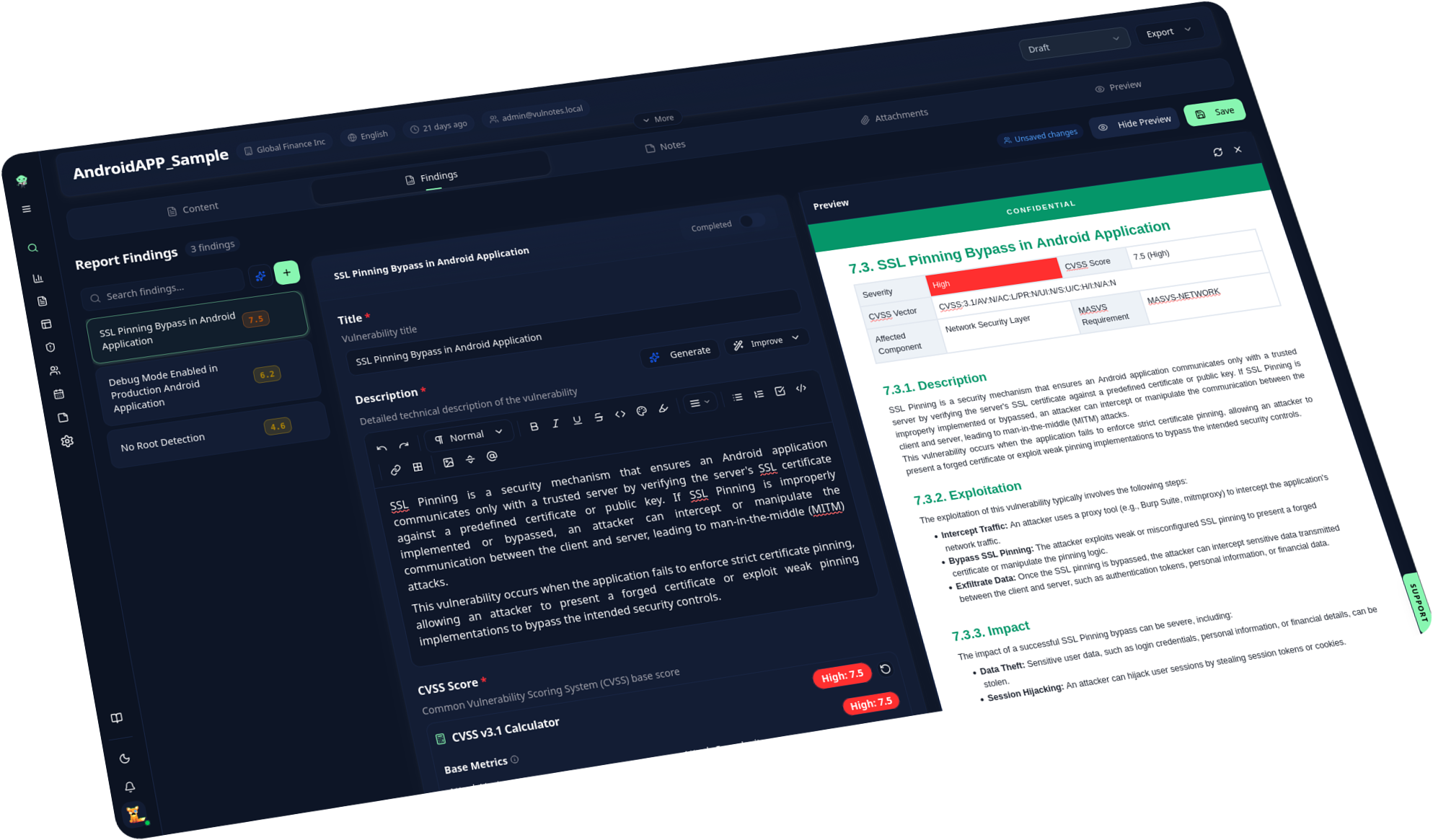
Looking for a Dradis alternative? Vulnotes lets your team design report templates visually with a live preview, write the same report together in real time, review it with snapshots and annotations, and export to DOCX, PDF, XLSX and JSON. Run it as a SaaS (Europe by default, other regions on request) or self-hosted for the same €48 per user per month, with built-in EU-hosted AI that anonymizes recognized sensitive data before each request. Dradis is a self-hosted collaboration and reporting platform with a free Community Edition and tiered paid plans. Here is how Vulnotes compares.
Dradis information checked on 29 October 2026 against its public documentation and pricing. Dradis is a trademark of Security Roots Ltd.

Vulnotes vs Dradis
- SaaS or self-hosted, same price
- Visual template builder
- Live co-editing
Vulnotes or Dradis: which one fits your team?
Vulnotes
Choose Vulnotes if…
- You want to design report layouts in the browser and see the paginated pages while you edit, or start from the Word report you deliver today.
- Several testers write the same report at the same time and want live cursors and per-field presence.
- You want the choice of a SaaS in the hosting region you need or self-hosting at the same price, with monthly or annual billing.
- You want SSO, the API, webhooks and an MCP server with read and write tools in one plan.
- You want AI included, or on your own provider or a local model, with recognized client data anonymized before each request.
Dradis
Choose Dradis if…
- You want a free, open-source limited edition to self-host and modify.
- Importing scanner output into one project is central to your workflow.
- You want the vendor to build your Word template from your current report, included in its paid plans.
Vulnotes vs Dradis: feature comparison
| Capability | Vulnotes | Dradis |
|---|---|---|
| Deployment | VulnotesSaaS (Europe by default, other regions on request) or self-hosted (Docker Compose); Air-Gap Server and Air-Gap Workstation editions | DradisSelf-hosted only, air-gap supported |
| Paid pricing | VulnotesOne plan at €48 per user per month, billed monthly or annually, same price for SaaS or self-hosted | DradisFrom €90 per seat per month, billed yearly |
| Import and integrations | VulnotesDOCX and DOTX template import, PwnDoc importer, standardized JSON import and Python SDK; Jira, GitHub and Azure Boards through the Client Portal add-on | DradisScanner importers; Jira, Azure DevOps and ServiceNow from the Remediate plan |
| Finding editor | VulnotesRich-text editor; fields come from structured vulnerability templates | DradisTextile markup |
| Report templates | VulnotesVisual drag-and-drop builder in the browser with paginated preview; DOCX and DOTX import | DradisWord and Excel templates |
| Export formats | VulnotesPDF, DOCX, XLSX, JSON, password-protected ZIP | DradisWord, Excel, HTML, PDF and CSV |
| Simultaneous editing | VulnotesLive cursors, selections and per-field presence in the same report | DradisEdit-conflict warnings |
| Review workflow | VulnotesAutomatic snapshot at review, side-by-side and changes views, annotations, included | DradisQA states (paid plans only) and comments |
| AI assistance | VulnotesBuilt-in EU-hosted Vulnotes AI or your own provider, including Ollama and OpenAI-compatible endpoints; anonymization before each request | DradisEcho, with local or cloud models |
| Client-facing portal | VulnotesWhite-label Client Portal add-on at €10 per Vulnotes user per month: statuses, retest requests, deliverables, Jira, GitHub and Azure Boards | DradisResults Portal on paid plans; Remediation Tracker from the Remediate plan |
| SSO and 2FA | VulnotesLDAP, Microsoft Entra ID and Google sign-in, plus 2FA, in the single plan | Dradis2FA on paid plans; SSO Enterprise plan only |
| Risk scoring | VulnotesCVSS 3.1 and 4.0 calculators, custom scoring | DradisCVSS, DREAD and MITRE ATT&CK |
| API and agents | VulnotesREST API, webhooks, Python SDK and an MCP server with read and write tools, included | DradisREST API; webhooks on paid plans only |
| Finding library | VulnotesReusable multilingual vulnerability library; imports from PwnDoc and a standardized JSON format | DradisIssue Library, paid plans only |
Report templates: a visual builder instead of Word content controls
Dradis report templates are Word and Excel documents prepared with content controls mapped to your project fields.
In Vulnotes, report templates are designed in the browser: pages, headers and footers, tables, charts, a table of contents and finding loops, with variables filled from each report and the paginated result visible while you edit. You can import an existing Word report or .dotx template and Vulnotes converts it into an editable layout. Nobody on the team needs Word to change the design, and every report still exports to DOCX, PDF, XLSX and JSON.
Real-time collaboration and review for pentest teams
Dradis warns you when someone else modifies the content you are working on, and review relies on QA states and comments, with QA on paid plans only.
In Vulnotes, several testers work in the same report at the same moment, with live cursors and per-field presence, so a team can split findings and finish the report together. Moving a report to review creates a snapshot; reviewers compare it with the live report side by side or as a list of changes and annotate both. Drafting keeps moving while review happens, and every change is visible before delivery.
Findings, library and automation
Vulnotes gives every report a reusable multilingual vulnerability library, structured vulnerability templates and CVSS 3.1, CVSS 4.0 or custom scoring. Findings can be written by hand, drafted with AI from a text prompt or a screenshot, or brought in through the standardized JSON import and the PwnDoc importer.
For your own pipeline, the REST API, Python SDK, webhooks and MCP server push findings straight into the same reports, and engagement planning with availability and conflict detection keeps the team's schedule in the same place.
Self-hosted or SaaS: a Dradis alternative you can run either way
Dradis runs only on infrastructure you control, including air-gapped networks.
Vulnotes gives you the choice at the same price: a SaaS hosted in Europe by default (other regions on request), or a self-hosted Docker install on your own servers. For disconnected networks, the Air-Gap Server and Air-Gap Workstation editions run fully offline with offline licensing and signed updates.
AI for pentest reports, with anonymization built in
Dradis Echo connects to local or cloud AI models.
Vulnotes includes AI in the plan: 1M tokens per user per month on EU-hosted Vulnotes AI, or your own provider among 12 provider types, including Ollama and OpenAI-compatible local models. Before each request, Vulnotes anonymizes recognized client names, person names, emails, IP addresses, hostnames, scope entries and credential patterns, then restores them in the response. Its MCP server exposes read and write tools, so AI clients can work on findings and reports within the permissions of their API key.
Dradis pricing vs Vulnotes pricing
Dradis offers a free Community Edition and paid plans billed yearly per seat, starting at €90 per seat per month. Remediation tracking and the Jira, Azure DevOps and ServiceNow integrations start on the Remediate plan, and SSO is on the Enterprise plan only.
Vulnotes has one simple price: €48 per user per month, billed monthly or annually, for SaaS or self-hosted, with SSO, the API, the MCP server and all export formats included. The white-label Client Portal is an optional add-on at €10 per Vulnotes user per month, read-only Viewer Seats are €24 per viewer per month, and a 14-day trial is available when you schedule a demo.
How to migrate from Dradis to Vulnotes
A move from Dradis uses the DOCX template import for your report layout and the standardized JSON import for your issue library. Try it on a few recent engagements before switching the whole team.
- 1
Import a generated report as your starting template
Export a recent Dradis report to .docx and import it in Templates > New Template > Import JSON or DOCX. Report values come in as plain text: replace them with variables and finding loops, then check every page in preview.
- 2
Recreate your issue fields
Build a Vulnotes vulnerability template with the fields your Dradis issues use, such as title, description, solution, references and a CVSS 3.1 or 4.0 field, and link it to the report template.
- 3
Convert your Issue Library
Write a script, for example with the Vulnotes Python SDK, that turns your Dradis issues into the Vulnotes standardized JSON format with formatted text as HTML, then import it from Administration > Settings > Integrations.
- 4
Connect your tooling
Attach raw tool output to the report as files, or create findings from your own scripts through the REST API, Python SDK or MCP server.
- 5
Set up access, AI and client delivery
Configure SSO or LDAP, choose an AI provider or a local model, and enable the Client Portal add-on to give your clients remediation tracking and retest requests.
Common questions
What is the best Dradis alternative?
For pentest teams that want to design, co-write and review reports in one place, Vulnotes is a strong Dradis alternative. It combines a visual template builder with live preview, real-time co-editing, snapshot-based review and built-in EU-hosted AI, as SaaS or self-hosted at €48 per user per month.
How much does Dradis cost?
Dradis has a free Community Edition, and its paid plans start at €90 per seat per month, billed yearly, with SSO only on the Enterprise plan. Vulnotes costs €48 per user per month, billed monthly or annually, with SSO, the API and all export formats included, and a 14-day trial when you schedule a demo.
Dradis vs Vulnotes: which is better for pentest reports?
Dradis suits teams that want a self-hosted platform with an open-source edition. Vulnotes is focused on producing and delivering the report: a drag-and-drop template builder, live co-editing, review with change view and annotations, and exports to DOCX, PDF, XLSX and JSON.
Is there a cloud alternative to Dradis?
Dradis is self-hosted only. Vulnotes offers a SaaS hosted in Europe by default (other regions on request) and a self-hosted Docker edition at the same price, so you can start in the cloud and keep the option to move on-premises.
How do I migrate from Dradis to Vulnotes?
Import a report generated by Dradis as a .docx into the Vulnotes template builder, then convert your Issue Library to the standardized JSON format, for example with the Python SDK. Replace client-specific text with Vulnotes variables and finding loops, and check the result in preview.
Can Vulnotes run air-gapped like Dradis?
Yes. Besides the SaaS and the standard self-hosted edition, Vulnotes offers an Air-Gap Server for disconnected networks and an Air-Gap Workstation for a single isolated machine, with offline licensing and signed offline updates. AI in these editions runs on a local provider such as Ollama.
Is there a Dradis alternative with AI and data anonymization?
Vulnotes includes EU-hosted AI with 1M tokens per user per month, or lets you use your own provider, including local Ollama or OpenAI-compatible models. Before each request, it anonymizes recognized client names, person names, emails, IP addresses, hostnames, scope entries and credential patterns.
See your own report
in Vulnotes.
Set up in minutes. Write, review and deliver your next pentest report in Vulnotes.